Snowmelt
Partitioning in Discontinuous Permafrost:
A Component of GEWEX-MAGS (Global Energy and Water Cycle
Experiment- Mackenzie GEWEX Study)
Collaborators: Drs. A. Pietroniro & T.D. Prowse (NHRC, Saskatoon)
Excerpt from October 1998 Progress Report
Temporal changes in the volume
of snowmelt contributions to streamflow are being compared in
five streams near Fort Simpson to examine the effect of basin
characteristics such as gradient, size, and vegetation coverage
and distribution on the hydrograph response. A two-point mixing
approach has been employed, which relies on the distinct isotopic
signatures of snow versus summer streamflow. Extensive snow
surveys, including isotopic sampling, were conducted prior to
snowmelt for each terrain classification unit used in the
WATFLOOD model. These results, in combination with land
classification data for each basin, have been used to estimate
snow water equivalent and snowpack isotopic compos ition for each
basin. Importantly, the isotopic composition of the snowpack in
open-water and wetland areas is found to be substantially more
variable than in forested areas. This is attributed primarily to
incorporation of lake or fen water into the snowpack by overflow/subsidence
of ice over the course of the winter. The isotopic composition of
summer streamflow, collected during late July through early
October, is found to be distinct for each basin, primarily
reflecting differences in the fraction of contributions from
evaporated versus non-evaporated source waters. Isotopic data for
snowpack and summer streamflow are used to partition snowmelt
contributions to streamflow between the onset of melt and late
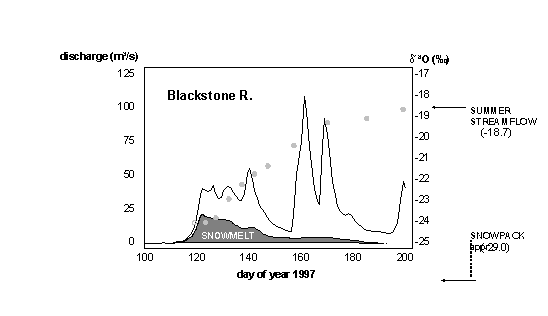
July. An example of results obtained for the Blackstone River is
shown below. Most notably, the abrupt decline in snowmelt
contributions around day 150 corresponds to the observed
transition from runoff via macropore/ interflow to
groundwater flow. Such information will be useful to compare with
the model results.
Time-series of discharge from the Blackstone River during the spring freshet of 1997 (Water Survey of Canada), and snowmelt discharge based on d18O of streamflow (grey circles) and surveys of snowpack and summer streamflow.
Similar results were obtained in all five basins, however, the timing of the snowmelt hydrograph is also found to be distinct for each basin, due not only differences in the mean transit times of water, but also potentially due to variations in the relative importance of flow pathways. Importantly, variability in basin isotopic response appears to be systematically related to basin gradient and land classification units which supports the use of a distributed model approach in the present setting. Very different responses were observed for individual basins for 1997 and 1998 (not shown), primarily due to a lighter-than-normal snowpack during the latter year.