- Which of the following is the best definition of a strategy?
- A strategy is an action that is always a best response to any choices made by other players.
- A strategy is an action that is a player’s best possible choice, given what other players are choosing to do.
- A strategy is an action that is chosen based on a player’s expectation about the choices made by others.
- A strategy is a list specifying a move for every point in a game where a player might be required to take an action in any possible play of the game.
- In which of the following games does player A have the same ordinal preferences?
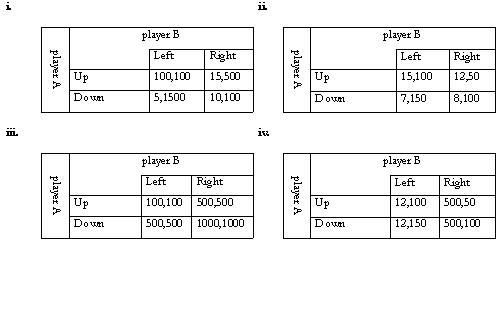 title="OrdinalComparisons" width="504" height="321" style="display: block; margin-left: auto; margin-right: auto; text-align: center;">
- (i) and (ii)
- (iii) and (iv)
- none
- all
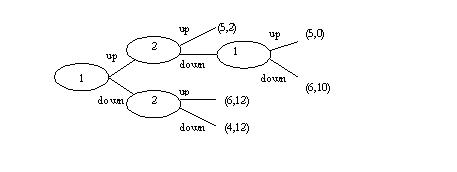
- How many strategies does Player 1 have in the following extensive form game?
- Four
- Three
- Two
- It depends on the choice made by player 2
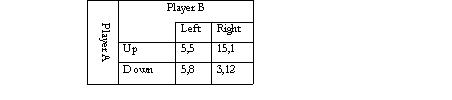
- Which statement is true about the following normal form game?
- (Up, Left) is a Nash Equilibrium
- (Up, Right) is a Nash Equilibrium
- (Down, Left) is a Nash Equilibrium
- (Down, Right) is a Nash Equilibrium
- Which of the following statements is true?
- A dominant strategy is another name for a best response.
- Best responses are dominant strategies in sequential move games.
- Contingent strategies lead to payoffs that depend on the choices made by other players.
- In a dominant strategy equilibrium all players choose best responses to every strategy available to the other players.
- In the game of chicken
- Players want to coordinate and choose the same action
- Players want to coordinate and choose different actions
- There is no Nash Equilibrium
- Players have a dominant strategy to be aggressive
- Social Dilemmas
- Can be solved if everyone recognises the benefit of getting along
- Have a dominant strategy equilibrium that is efficient
- Have a dominant strategy equilibrium that is not efficient
- Are games where players cannot decide what strategy to choose
- Matching Pennies
- Is a game where all players would prefer to move first
- Has a Nash Equilibrium in which players both choose Head
- Has a dominant strategy equilibrium
- Has no pure strategy Nash Equilbrium
- How many subgames are there in the following game?
- One
- Two
- Three
- Four
- Subgame perfection requires
- No player to be surprised by the choices made by others
- Strategy choices to constitute a Nash equilibrium on every subgame
- All players to use backwards induction to solve a subgame
- Players to choose Nash Equilibirum strategies in a sequential game