Published in Bunker,
B., & Thorpe, R. (1986). The curriculum model. In R. Thorpe, Bunker, D.,
& Almond, L (Ed.), Rethinking games teaching (pp. 7-10).
Loughborough: University of Technology, Loughborough.
© This material may not be reproduced, stored in a retrieval system or
transmitted by any means, electronic, mechanical, photocopying without the
permission of the copyrightholder
THE
CURRICULUM
MODEL
David Bunker and Rod Thorpe
The model
as outlined and explained in this paper, is fundamental to our understanding of
what 'teaching for understanding' is about. Not only does it provide a
theoretical base from which to work, it also gives guidance for those planning
sessions insofar as it places its elements in temporal sequence. When we are
asked to present lectures, to lead seminars and to conduct practical sessions,
the model represents the starting point for our preparation.
Observation
of present games teaching shows at best, a series of highly structured lessons
leaning heavily on the teaching of techniques, or at worst lessons which rely
on the children themselves to sustain interest in the game. This paper is based
on the opinion that these approaches have led to:
a) a
large percentage of children achieving little success due to the emphasis on
performance, i.e. "doing"
b) the
majority of schoolleavers "knowing" very little about games
c) the
production of supposedly "skilful" players who in fact possess
inflexible techniques and poor decision making capacity
d) the
development of teacher/coach dependent performers
e) the
failure to develop "thinking" spectators and "knowing"
administrators at a time when games (and sport) are an important form of
entertainment in the leisure industry.
As a
large amount of time is given over to the teaching of games within the
programme of Physical Education, it is surprising that little or no attention
has been given to the ways in which they can be taught in schools. It is of
particular concern as games, unlike other activities in the Physical Education
Curriculum, present problems of "what to do?" and "when to do
it?" and not just 'how it is done?"
It could
be said that traditional methods have tended to concentrate on specific motor
responses (techniques) and have failed to take account of the contextual nature
of games. For example, it is usual to teach a very prescribed response, say,
the overhead clear in badminton, before the children have grasped the
significance of the shot within the game, which in this case is to drive the
opponent to the back of the court. The tendency is for teachers to teach
"how?" before they teach "why?". It is our belief that if
the emphasis shifted to tactical considerations in a game children will
recognise that games can be interesting and enjoyable as they are helped and
encouraged to make correct decisions based upon tactical awareness. At this
point children should begin to see the need for, and relevance of, particular
techniques as they are required in the game situation. Whereas the typical
reaction to a lesson based on the teaching of techniques is "when can we
play a game?" this new approach should (p. 7) elicit the response
"how can we do it?" - the child is beginning to appreciate the
tactical necessity for improving the specific technique required in a
particular game situation.
The
following model outlines the procedure, step by step, whereby the teacher helps
the child to achieve a new level of skilful performance. While absolute levels
of performance will vary, each and every child is able to participate in
decision-making based upon tactical awareness thereby retaining an interest and
involvement in the game.
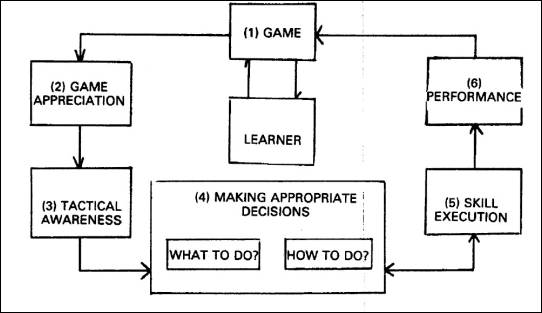
Figure
1 The curriculum model.
1. GAME
FORM. While the full adult version of the game presents a long term goal at
which to aim and provides guidelines for teachers, it is necessary, in the
early years of the secondary school, to introduce children to a variety of game
forms in accordance with their age and experience. In doing so it is important
to give careful thought to the area of the playing surface, the numbers to be
involved and the equipment to be used in the attempt to present children with
the problems involved in playing games, fundamentally, creating space to attack
a target while being denied space by the opposition. Provided that an
appropriate game situation is set up, the pattern of a mini-game played by 11
and 12 year olds can bear a close resemblance to the adult version of the game.
2. GAME
APPRECIATION. From the outset children should understand the rules of the game
to be played, no matter how simple they may be. It is important to remember
that the rules give the game its shape. Increasing the height of a net slows
the game down and increases the duration of rallies; reducing the number of fielders
in a striking game increases the chances of scoring runs; increasing the size
of a target in an invasion game makes it more difficult for defenders to
protect their goal. Additionally the rules will place constraints of time and
space on the game, will state how points (goals) are scored, and more (p.
8) importantly, will determine the
repertory of skills required. It is axiomatic that alterations to the rules of
a game will have implications for the tactics to be employed.
3.
TACTICAL AWARENESS. Given some involvement and an under- standing of the rules,
it is necessary to consider now the tactics to be used in the game. Ways and
means of creating space and denying space must be found to overcome the
opposition. The principles of play, common to all games, form the basis for a
tactical approach to the game, e.g. achieving more penetration as a result of
practising fast-break attacks. Of course game plans do not always work and
tactics must be changed to meet the needs of the moment.
It should
be added that tactical awareness should lead to early recognition of opposition
weaknesses e.g. a poor backhand, a dislike of tackling, a reluctance to catch a
hard ball, but this should not be allowed to destroy the game which should be
modified to restore the competitive nature of an evenly matched game.
4.
DECISION MAKING. Proficient games players take only fractions of a second to
make decisions and they would see no value in distinguishing between the
"what?" and the "how?". In this approach to games there is
a difference between decisions based upon "what to do?" and "how
to do it?" thus permitting both the learner and teacher to recognise and
attribute shortcomings in decision making.
a)
"What to do?" Whilst it is obvious that tactical awareness is necessary
if decisions are to be made, it is in the very nature of games that
circumstances continually change. In deciding what to do each situation has to
be assessed and thus the ability to recognise cues (involving processes of
selective attention, cue redundancy, perception etc.) and predict possible
outcomes (involving anticipation of several kinds) is of paramount import-
ance. For example, there is no value in understanding that attacking a space
near the goal in an invasion game may be highly desirable but may carry the
risk of losing possession, if the" cues cannot be recognised in the first
place.
b)
"How to do it?" There still remains the decision as to what is the
best way to do it and the selection of an appropriate response is critical. For
example, where a large space is available but time is limited a quickly
executed response may be appropriate whereas when time is available but
accuracy is vital some element of control prior to execution may be necessary.
Such situations often arise in the shooting area of invasion games.
5. SKILL
EXECUTION. In the model skill execution is used to describe the actual
production of the required movement as envisaged by the teacher and seen in the
context of the learner and recognising the learners limitations. It should be
seen as separate from "performance" (see 6 below) and may include
some qualitative aspect of both the mechanical efficiency of the movement and
its relevance to the particular game situation. For example, a young child may
well produce an excellent defensive clear in badminton in that there is
efficient racket head speed and a good angle of contact which puts the shuttle
behind the opponent. The shuttle may not reach the back of the full size court
due to a lack of strength and/or a lack of technical (p. 9) development but
would still be classified as an excellent defensive clear. Skill execution is
thus always seen in the context of the learner and the game.
6.
PERFORMANCE. This is the observed outcome of the previous processes measured
against criteria that are independent of the learner. It is that by which we
would classify children as good or bad players whether at school or
international level and should be a measure of appropriateness of response as
well as efficiency of technique.
CONCLUSION.
The sequential aspects of the model are critical. Unlike traditional teaching
methods this approach starts with a game and its rules which set the scene for
the development of tactical awareness and decision making, which, in their
turn, always precede the response factors of skill execution and performance.
Satisfactory completion of the stages as outlined will necessitate modification
of the game leading to a careful re-appraisal of the requirements of the new
game. The cycle has begun again. While children may be pre-occupied with anyone
component of the model at anyone time this will always be in the context of an
appropriate game with the result that many of them will experience some of the
satisfaction of the skilful player.
Reference
Bunker,
D. and Thorpe, R., A Model for the Teaching of Games in Secondary Schools in
the Bulletin of Physical Education, Volume 18 No.1, Spring 1982.