The following are results of some experiments and measurements which pertain to the concepts of string vibration, resonnace and spectral analysis, as discussed in MUS 401C/508. All measurements were carried out using a Hohner HC09E nylon string guitar, and recorded using Silver Line XT-HS75MV microphone at approximately 10cm from sound hole. Spectral analysis was carried out by Audacity. Additional spectral visualization by sndpeek (freeware).
-
The effect of stopped string harmonics on percieved pitch and spectra
As discussed in class, the guitar frets are positioned in close correspondance with the rule of 18 (that is, every fret is positioned 1/18th of the distance to the bridge further than the following one), so as to create an equal tempered tuning. Stopping the string at points which divide the string into integer ratios causes the production of 'natural harmonics'. The open low E string (tuned to 82Hz) and its subsequent 5 first harmonics have been recorded, and their spectra visualized using audacity (1 second lengths were used for averaging. Initial envelops were not included in order to reduce noise). The results are as follows:
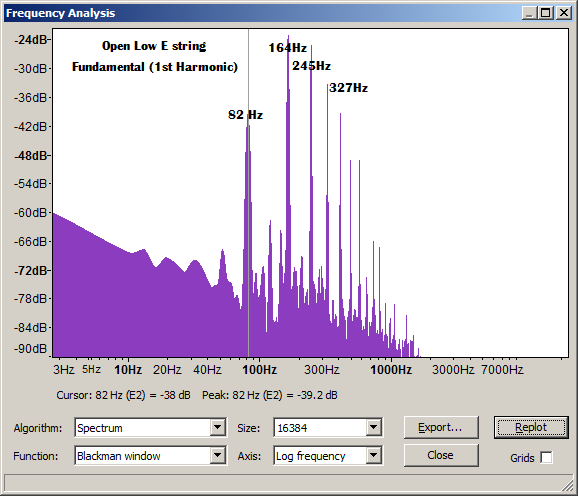
Figure1: Open Low E String. Fundamental (1st harmonic) 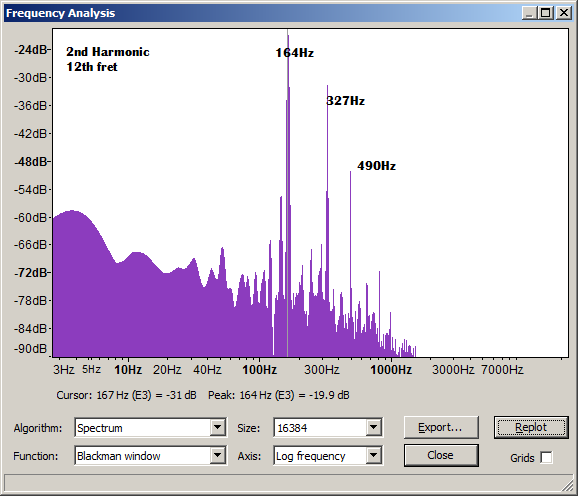
Figure2: 2nd harmonic, 12th fret 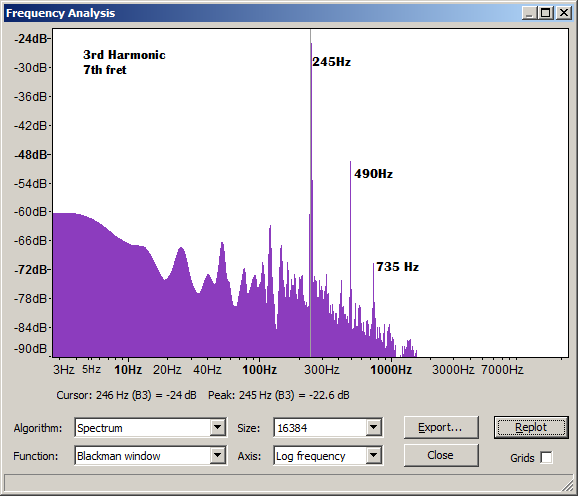
Figure3: 3rd harmonic, 7th fret. 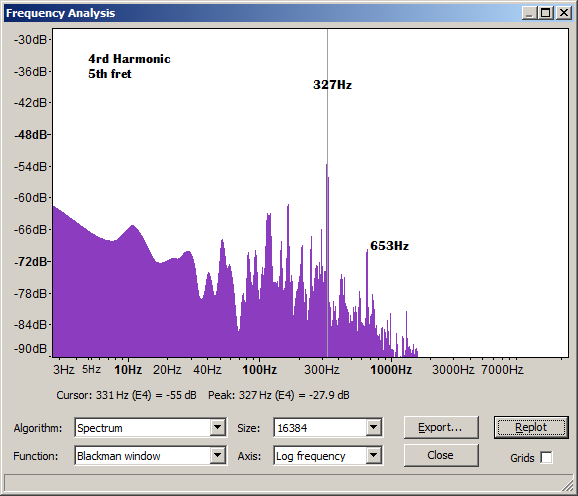
Figure4: 4th harmonic, 5th fret. 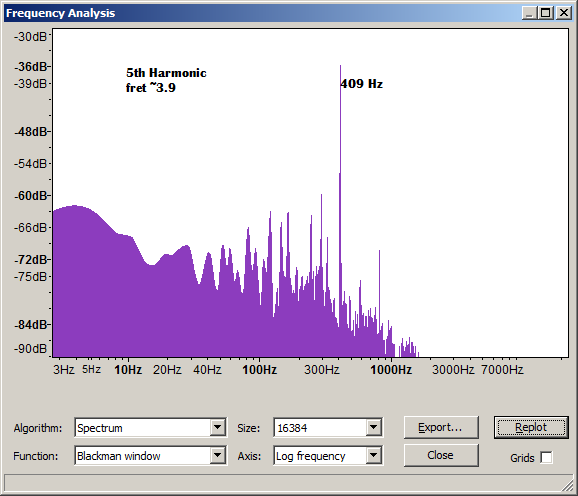
Figure5: 5th harmonic, fret ~3.9 Several Observations can be made: First, we notice that the spectrum peaks are very close to what we anticipate from a harmonic series, despite very simple recording hardware and software. Further, as we progress along the harmonic series, the relative amplitude between our percieved fundamental peak and the consecutive harmonics increases. As we have noted in class, the relative absense of spectral peaks in higher harmonics contributes to the 'hollow / shrill' sound of the guitar string in these cases. The effect also accounts for the relative diminishing loudness (despite the fact that the string is plucked with very nearly constant force for all harmonics). All of the spectra contain an inaudible noise floor, especially near very low frequencies. It is my assumption that these can be attributed to hardware noise, but also to resonances incured by the body of the guitar (and possibly other ambient sympathetic vibrations picked up by the microphone). As an example of equipment noise, we can see a fairly distinct (albeit small) peak at 50Hz in all of the spectra, which most likely corresponds to grid frequency.
-
Timbre and effects of string choice
String instruments in general and the guitar in particular allow for the same pitch to be played using different strings. The selection of 'which string to play a particular note on' usually depends on the ability of the guitarist to select the desired tambre, combined with the physical playability of a given note on a given string (in much of the repertoire, especially where multiple voices sound simoultaniously, the choice of string is very constrained. The ability to choose is much greater in single line passages). To investigate the spectral differences between notes on different strings, we will use B3, which sounds on the 6th (Low E string) on the 19th fret, 5th (A) string on the 14th fret, 4th(D) on the 9th fret, 3rd (G) string on the 4th fret, and on the open 2nd (B) string. The theoretical frequency of the pitch corresponding to B3 is 247Hz. In order to minimize experimental inconsistensies, the guitar was tuned to standard tuning within 1 cent for each of the strings. The recording was carried out at 2cm distance from the sound hole. All strings were plucked by the thumb.
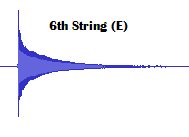
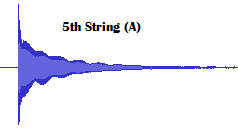
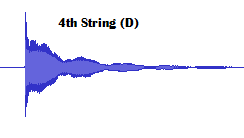
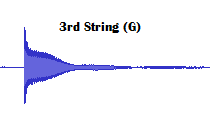
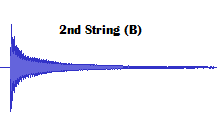
From the envelopes above, we observe that plucking the 6th, 5th and 2nd string, where the frets used are on the extremities of the guitar neck (or the string is unfretted, which is theoretically equivalent to considering the guitar nut as a fret), results in the expected exponential decays. Interestingly, for the 4th and 3rd string, the initial decay is slower, but a more rapid cutoff is observed. These two strings, for which the B note is fretted closest to the middle of the bridge, also produce the most 'rounded' timbre quality. Throughout my reading, I have not found a satisfactory explanation for the uneven decay of strings 5 and 4. It is fairly reasonable to assume that the shape owes to the less consistent make and polish of frets in higher positions (which is often the case, even with higher end instruments). It is noteworthy to add that the fundamental spectral peaks for all strings were reasonably close to the theoretically anticipated 247 Hz mark (higher frets produce inconsistencies due to intonation issues, as expected). The most 'peaky' string was, surprisingly the open B string, even though it is aurally (and in practice) the least 'rounded' sound. As discussed in class, the fullness of timbre here may be the result of additional effects, such as attack, cutoff and envelope. To test this hypothesis, I have attempted to mask the first few miliseconds of each of the wave forms and play the resulting audio files. As expected, this showed that the resulting timbre (and in fact, our perception of the sound belonging to a guitar!) is affected greatly by the initial attack. This kind of demonstration is very easy to reproduce in a class setting, and can be readily used to demonstrate the effect of envelope on timbre.