Rationale

Introduction:
This Rugby unit was developed for a local middle school and specifically for grade 6. It was based on Maynard’s (1991) article discussing the proper progressions of drills at the beginning, middle and more advanced levels of learning the game concepts of rugby. The main concept behind Maynard’s article is the Teaching Games For Understanding (TGFU) which conveys the concepts of Rugby in a game-like situation to engage the students and aid in their own application of the game. Some of our teaching experience was trying to figure out what the students were capable within the sport of Rugby and developing the proper progressions at the right speed and this is where referring to our block plan will be greatly beneficial for teachers looking to use these concepts. After having applied Maynard’s progressions at this beginner we realized that a lot more time would be needed for the students to retain the concepts of this unfamiliar sport.
Tim Hopper’s 452 class has given us the building blocks to successfully implement the TGFU concepts into unit and lesson planning. Trying it out within a local middle school was an excellent experience. The TGFU model works on both the skills and tactics of the game. Skills are the performance aspects that relate to the technical and biomechanics break down of an action and tactics are the decision-making that allows you to have an advantage over your opponent (Hopper, 2007). The TGFU model emphasizes the application and retention of both of these aspects to game play. It does so by using small adapted games which are featured on this page when teaching rugby. The TGFU model allows students to develop on and off-the-ball skills while also learning the tactical decision-making skills based on awareness during different game situations (Mitchell, S., Griffin, L., & Olsen, J. 2006).
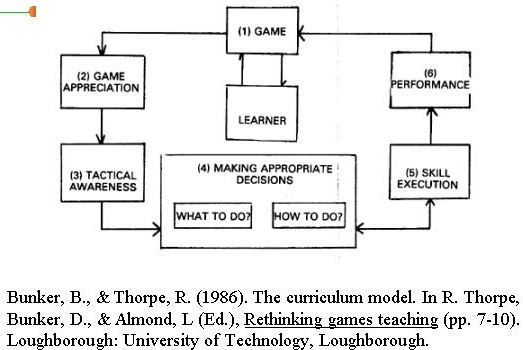
There should also be direct teaching incorporated during the middle of the lesson at the beginning level to ensure that proper skill acquisition is being accomplished. For example a game at the beginning and then transition into skill based drill such as passing or staggered passing and then a game that emphasizes the skill that was taught in the middle of the lesson. The unit that we have developed does not only have to be used on grade 6 age level, it can be used on any beginning level Rugby students or within a class with varying levels of skill. This can be achieved by the adaption of the drills and creating stages of drills within the lesson so that the students can move up as they feel comfortable. Dolittle (1995) develops these concepts within a Net/Wall unit and with a little bit of creativity and reference to Maynard,s () progressions this can easily be applied to a Rugby unit and within our lessons we incorporated this (Refer to Block Plan). Giving students the choice within the lesson of when and how they would like to progress allows them to feel comfortable while learning an unfamiliar sport so that they will not necessarily be deterred from pursuing it in the future.
References
Doolittle, S. (1995). Teaching net games to skilled students: a teaching for understanding approach. JOPERD. 18- 23.
Hopper, Tim. (2007). Assessing Learning in PE. PE 452. November 19, 2007.Victoria: University of Victoria.
Maynard, Ian (1991). An understanding approach to the teaching of rugby union. British journal of Physical Education, 22(1), 11-17.
Mitchell, Stephen A., Oslin, Judith L. and Griffin, Linda L. (2006). Teaching Sport Concepts and Skills: A Tactical Skill Approach. 2nd ed. Champaign: Human Kinetics.