



 .
.  .
.
 .
.  .
.  is effected by the near closure of the supraglottal
mechanism against the base of the epiglottis, resulting in the trilling
of the aryepiglottic folds.
is effected by the near closure of the supraglottal
mechanism against the base of the epiglottis, resulting in the trilling
of the aryepiglottic folds. 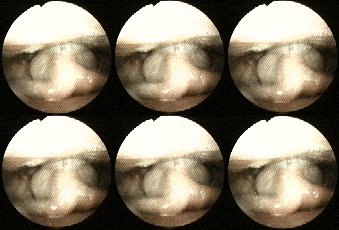
 .
. 
 through
 and
finally to
and
finally to |
|
Pharynx Research (created for web October 2000) by John H. Esling (phonetic production) and Lynn Marie Heap (camera and animations).
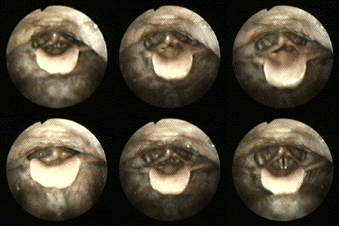
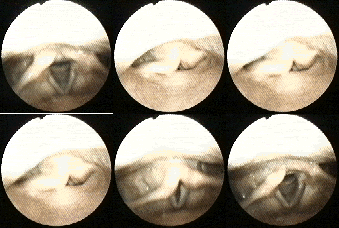
Laryngoscopic images of the pharynx and larynx obtained using a Kay Elemetrics Rhino-Laryngeal Stroboscope 9100, halogen light source, Olympus ENF-P3 fibreoptic laryngoscope, Panasonic KS 152 camera, and 28mm wide-angle lens: View from the naso-pharynx adjusted to view the glottis, pyriform recesses, arytenoids, and aryepiglottic folds, as far as possible behind the epiglottis. |
|
This articulation can |
The initial stop is glottal and the second
stop is pharyngeal, that is, the first involves the vocal folds
and ventricular folds in the stricture while the second involves
aryepiglottic fold constriction to achieve full closure of the supraglottal
mechanism against the base of the epiglottis. This mechanism is
observed to constitute the principal "pharyngeal articulator." This
interpretation views the pharyngeal stop as auditorily equivalent
to what has been called a "massive glottal stop," and to what has
been called an "epiglottal stop." The pharyngeal stop is represented
by the IPA symbol for an epiglottal stop HEAR THE SOUND (.wav 23k) |
This articulation is an intervocalic voiceless pharyngeal trill, |
Second movie: The IPA symbol for a voiceless
epiglottal fricative is used to indicate that the articulation involves
greater constriction than the voiceless pharyngeal fricative symbolized
by The distinction as shown here is that the "more constricted" sounding fricative
|
Voiced pharyngeal |
This articulation is the voiced equivalent , a
sustained voiced pharyngeal trill, represented by the voiced epiglottal
fricative symbol Requiring greater stricture than the homorganic
pharyngeal approximant , this articulation also involves the aryepiglottic folds pressing against the base of the epiglottis to effect a trill. HEAR THE SOUND (.wav 21k) |
These images are partial illustrations of the progressive degrees of glottal-laryngeal-pharyngeal closure from
Larynx height in all of these consonantal articulations is raised -- the unmarked position for lingual retraction/pharyngeal constriction. Pharyngeal constriction with larynx lowering is not shown here. The effect of these lingual/aryepiglottic maneuvres on pitch and on phonatory quality has yet to be made explicit. These images have been published in: (1996). Pharyngeal consonants and the aryepiglottic sphincter. Journal of the International Phonetic Association, 26, 65-88. For more information, please see: Esling, John H., & Clayards, J.A.W. (1999). Laryngoscopic analysis of pharyngeal articulations and larynx-height voice quality settings. In A. Braun (Ed.), Advances in phonetics (Zeitschrift für Dialektologie und Linguistik, Beiheft 106) (pp. 22-33. Stuttgart: Franz Steiner Verlag. Esling, John H. (1999). University of Victoria phonetic database (version 4.0). Victoria: Speech Technology Research Ltd. (and Lincoln Park, NJ: Kay Elemetrics Corp). Clayards, J.A.W., Holmes, M., & Esling, John H. (1999). A multimedia approach to learning phonetic transcription. Proceedings of the 14th International Congress of Phonetic Sciences, vol. 2 (pp. 1133-1136). Berkeley: University of California. Esling, John H. (1999). Voice quality settings of the pharynx. Proceedings of the 14th International Congress of Phonetic Sciences, vol. 3 (pp. 2449-2452). Berkeley: University of California. Esling, John H. (1998). Laryngoscopic analysis of pharyngeal articulations and larynx-height voice quality settings. Proceedings of the 5th International Conference on Spoken Language Processing, vol. 2 (pp. 543-546). Sydney: ASSTA. Esling, John H. (1998). Quantification of pharyngeal articulations using aryepiglottic angle measurements from laryngoscopic images (with J.A.W. Clayards, J.A. Edmondson, F-Y. Qiu & J.G. Harris). Proceedings of the 5th International Conference on Spoken Language Processing, vol. 7 (pp. 3091-3094). Sydney: ASSTA. |
|