Canadian Nuclear Physics for Astrophysics Network (CaNPAN)
Web page: https://www.canpan.ca
The Canadian Nuclear Physics for Astrophysics Network (CaNPAN) brings nuclear physics and astrophysics and astronomy in Canada together to investigate the origin of the elements. An important emphasis is on the training of students in a broader range of topics. Students with their main project in nuclear physics are gaining experience in astrophysical simulations that reveal the impact of measured data, and astrophysics modeling students get experience in possibilities and limitations of nuclear physics experiments. The collaboration focusses on investigating nuclear physics data impact on astrophysical simulations of how the elements are made, for example in the dynamic convective environments of white dwarfs or merging neutron stars.
Example works
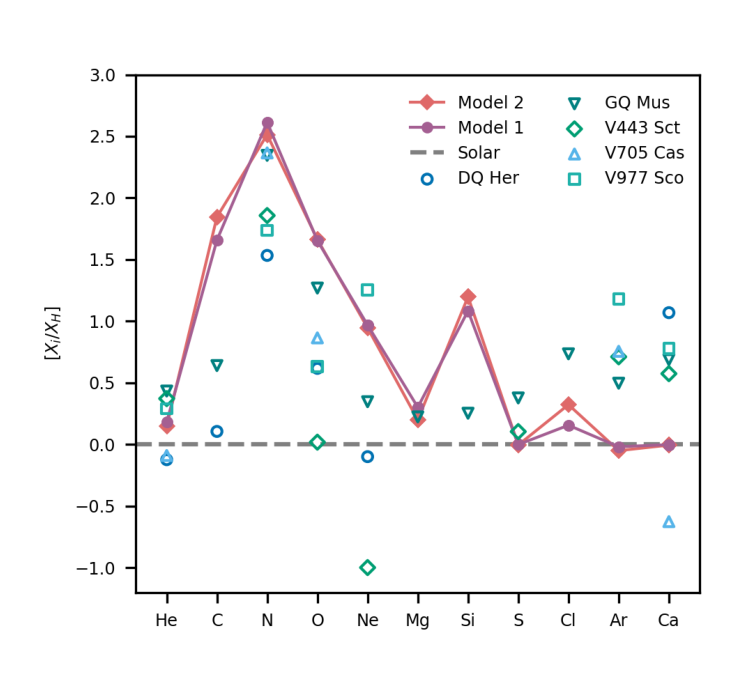
Calcium excess in novae: beyond nuclear physics uncertainties
Loria et al. (2025), ApJ 993, 156
Calcium abundances measured in classical novae over 65 years of observations are systematically higher than nova models predict. Monte Carlo simulations show this excess cannot be explained by nuclear reaction-rate uncertainties alone, pointing to missing physics in the models.
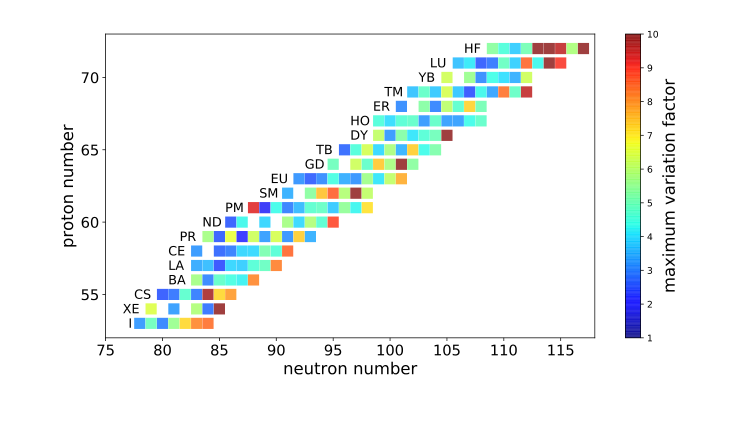
Impact of (n,γ) rate uncertainties of unstable isotopes on the i-process from Ba to W
Denissenkov et al. (2021), MNRAS 503, 3913
The heavy-element abundances of CEMP-r/s stars match intermediate neutron-capture (i-process) nucleosynthesis in rapidly accreting white dwarfs. Monte Carlo simulations identify which uncertain neutron-capture rates of unstable isotopes most limit the i-process abundance predictions from barium to tungsten.
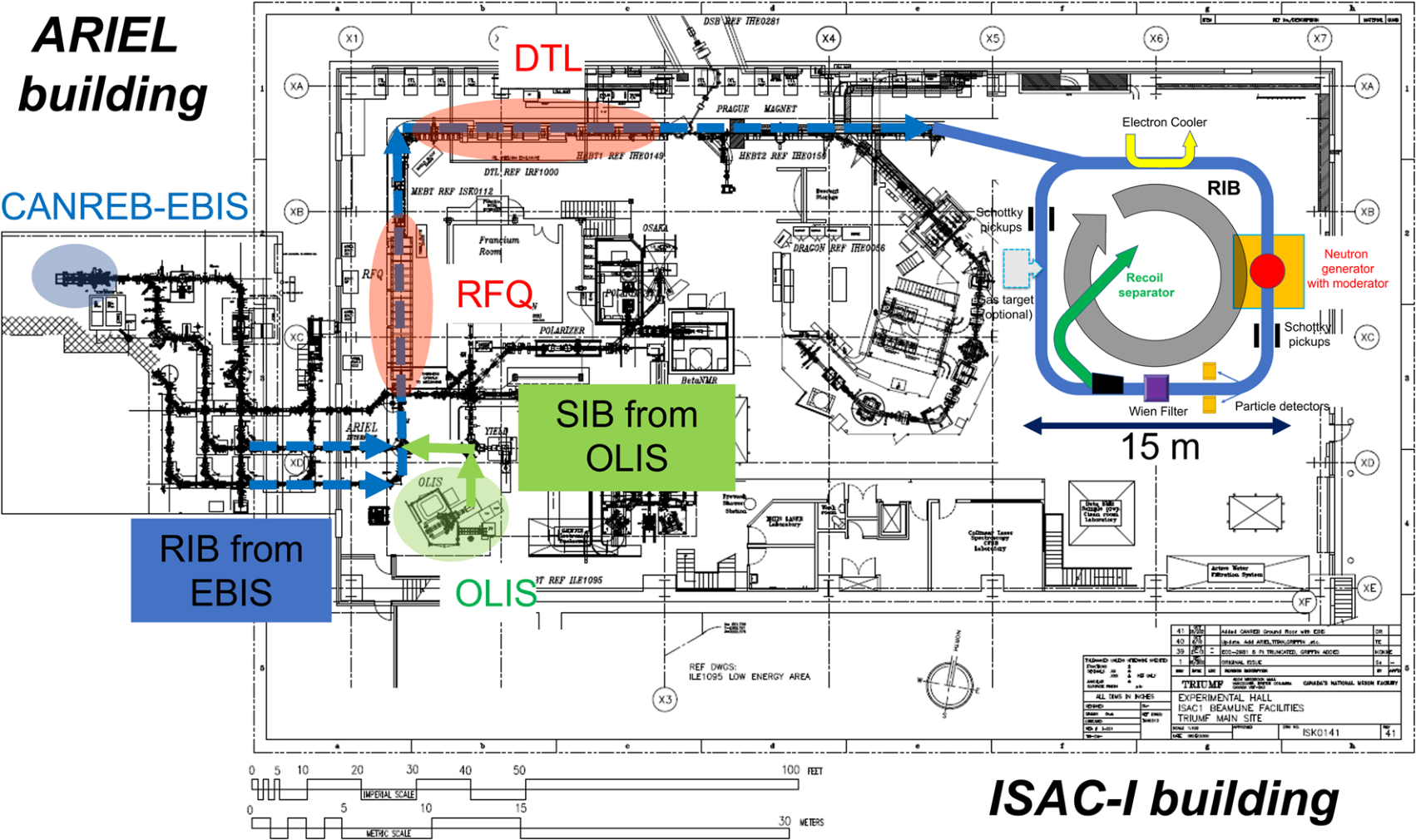
Measuring neutron capture cross sections of radioactive nuclei
Dillmann et al. (2023), EPJA 59, 105
Neutron-capture cross sections of short-lived radioactive nuclei are essential for understanding how the elements heavier than iron form, yet most cannot be measured with existing techniques. This paper reviews the path toward direct measurements in inverse kinematics using a proposed low-energy storage ring (TRISR) at TRIUMF.