NuGrid Collaboration
Web page: https://www.nugridstars.org
The NuGrid collaboration is an international collaboration of researchers in nuclear astrophysics, astronomy, and computational science. The collaboration is focused on the development of a comprehensive set of stellar evolution and nucleosynthesis tools to study the origin of the elements in the Universe.
Example works
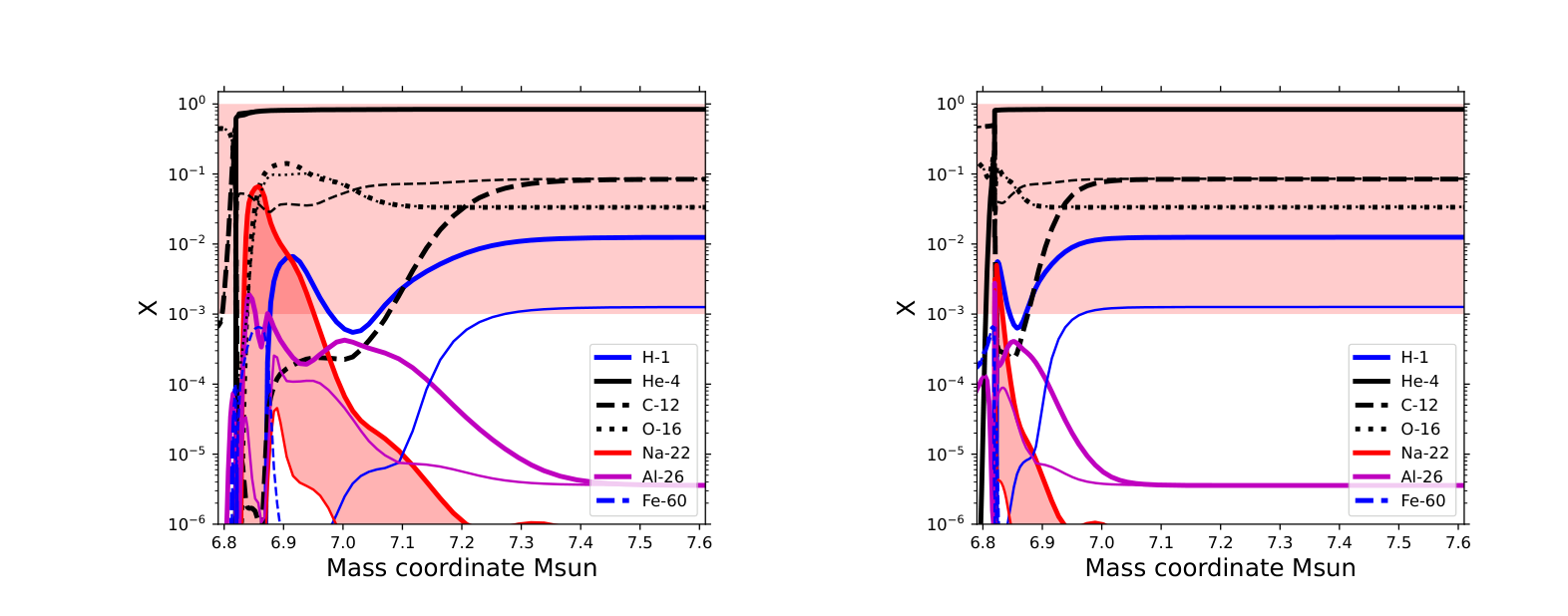
Production of radioactive ²²Na in core-collapse supernovae
Pignatari et al. (2025), ApJ 990, 19
Presolar graphite grains that condensed in supernova ejecta carry a puzzling ²²Ne-rich component, Ne-E(L). These models show that hydrogen ingested into the helium shell of a massive star, if it survives to the explosion, lets the supernova shock produce enough radioactive ²²Na (which decays to ²²Ne) to account for it.
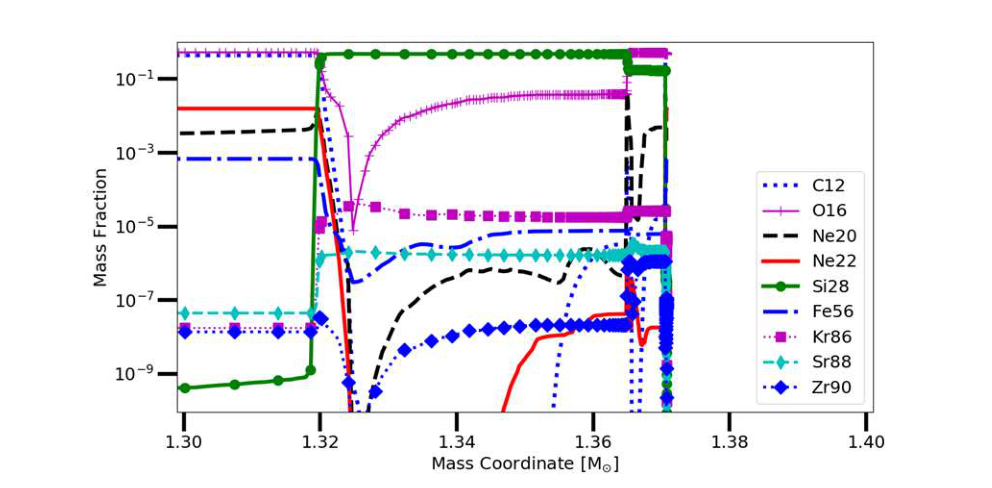
Trans-Fe elements from Type Ia supernovae
Battino et al. (2025), A&A 703, A44
A grid of five models of slowly merging carbon-oxygen white dwarfs approaching the Chandrasekhar mass shows that recurrent surface carbon flashes can synthesize elements beyond iron in the outer layers before a possible Type Ia explosion.
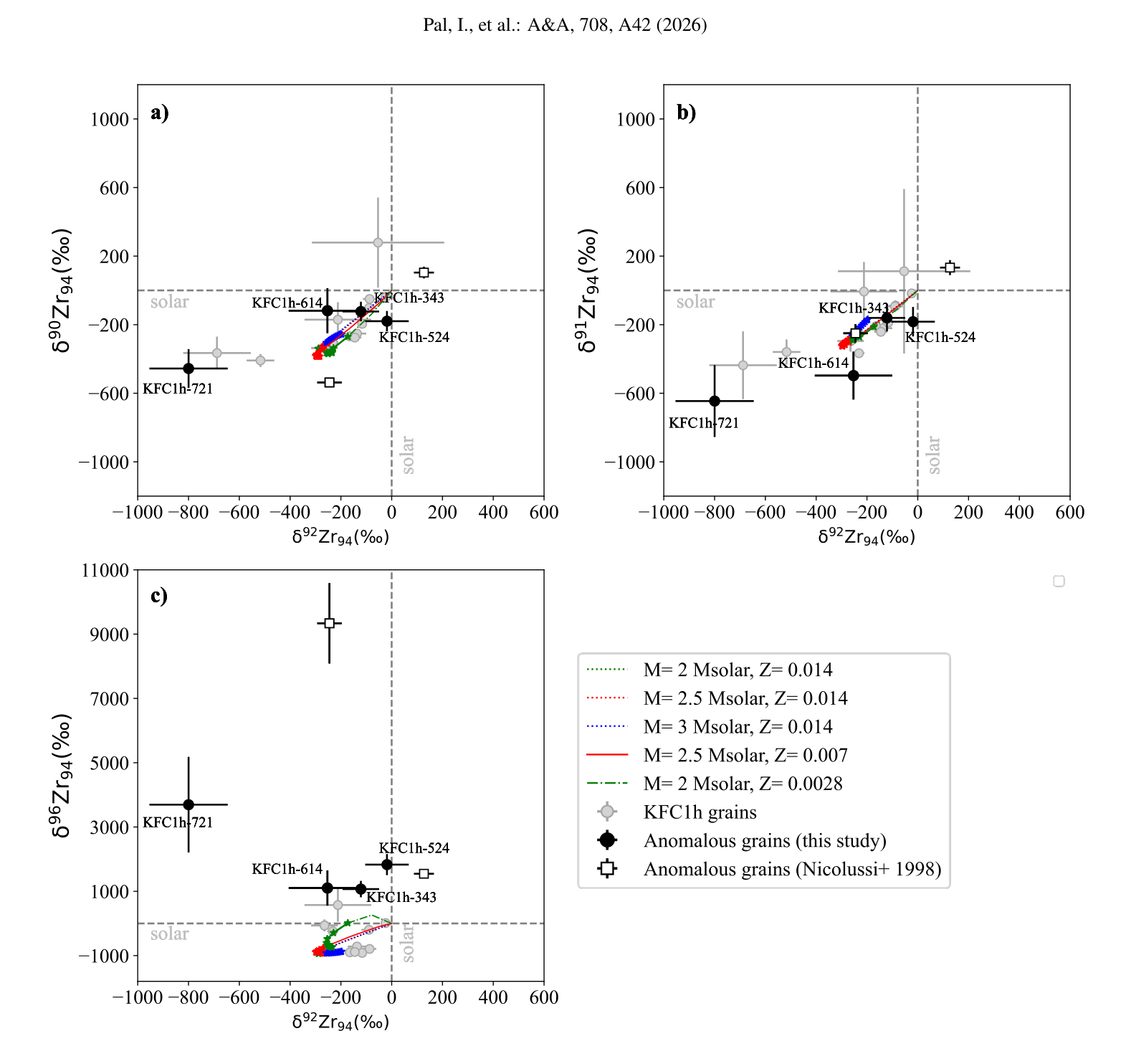
The stellar origins of ⁹⁶Zr excesses in presolar graphites
Pal et al. (2026), A&A 708, A42
Zirconium-96 can form in several neutron-rich environments. Comparing the zirconium isotopic ratios measured in presolar graphite grains from the Murchison meteorite with stellar models constrains which stellar sites produced the observed ⁹⁶Zr excesses.